



To Top
PFAS in Fish
IMPORTANT: Fish in Cane Creek Reservoir
Due to high levels of PFAS detected in game fish at Cane Creek Reservoir, OWASA recommends that you do not consume fish caught in Cane Creek Reservoir. Doing so will be at your own risk.
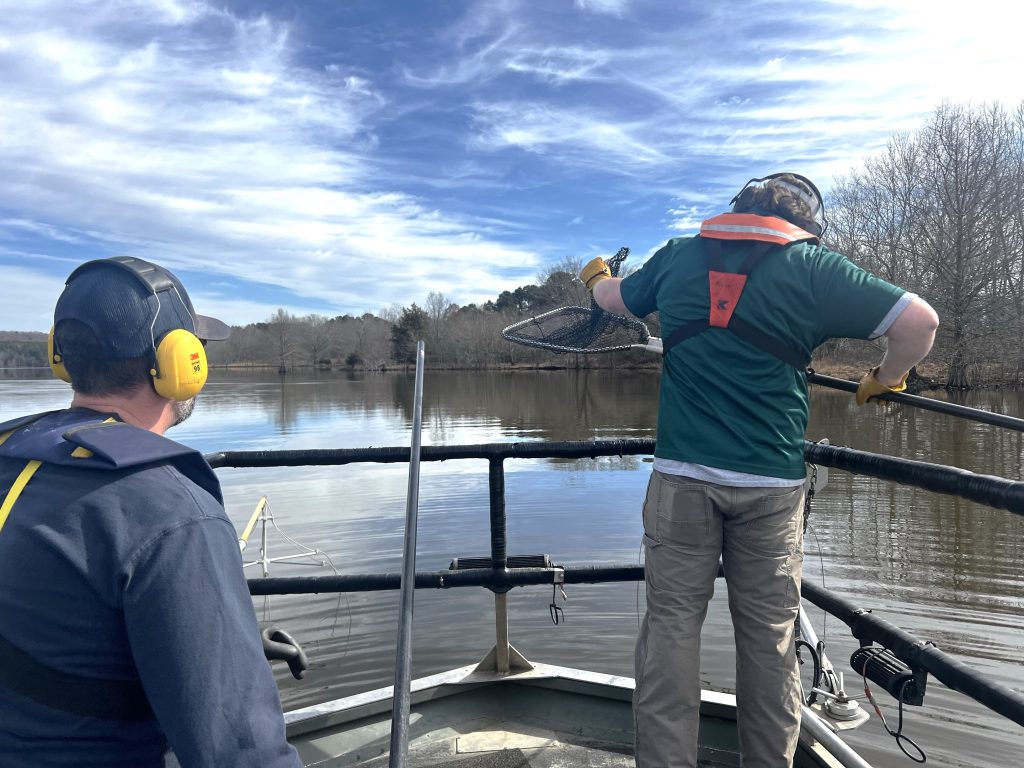
In fall 2024, results from studies at UNC-Chapel Hill showed high levels of PFAS found in fish in nearby Jordan Lake and the Haw River. Meanwhile, results from PFAS testing in the watershed of Cane Creek Reservoir had prompted OWASA to seek advice and assistance to test fish in the reservoir for PFAS. OWASA worked to collect five fish species commonly caught in the reservoir for testing. Fish collection for testing began in early 2025.
Recreation at Cane Creek and University Lake reservoirs is a tradition that has become a beloved part of spring and summer weekends for people from all over North Carolina—even for some from out of state! The lakes are treasured spots for birdwatching, kayaking, canoeing, and, especially, fishing. We hope to continue these traditions, but it is important that fishers and others in our community understand the impacts of PFAS, which can be found in fish.
PFAS in Fish Testing Results
In 2025, OWASA tested five species of fish caught in Cane Creek Reservoir and University Lake. The results are presented below, in parts per billion (ppb).
In Cane Creek Reservoir fish, one PFAS compound known to impact human health, perfluorooctane sulfonate (PFOS), was found to be at very high levels in four of the five tested species–largemouth bass, sunfish, crappie, and bluegill—and at a lower, but still significant, level in catfish.
PFAS Levels in Cane Creek Reservoir Gamefish
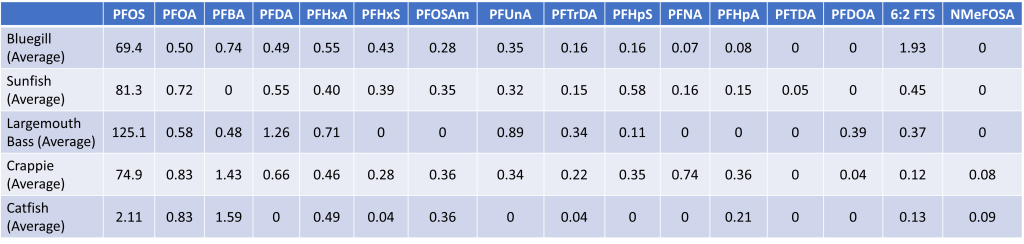
PFAS levels in fish are reported in parts per billion (ppb). For comparison, please note that PFAS levels in drinking water are reported in parts per trillion (ppt).
PFAS levels in fish in University Lake are much lower than PFAS levels found in the same fish in Cane Creek Reservoir. However, most of them still have enough PFAS to warrant reduced consumption. See the tables below for PFAS levels and consumption recommendations.
PFAS Levels in University Lake Gamefish

PFAS levels in fish are reported in parts per billion (ppb). For comparison, please note that PFAS levels in drinking water are reported in parts per trillion (ppt).
Maximum Consumption Recommendations for Gamefish Caught in University Lake
| Gamefish Species | Maximum Recommended Consumption |
| Bluegill | 1 meal per month |
| Bass | 3 meals per year |
| Crappie | 6 meals per year |
| Catfish | 1 meal per week |
| Redear Sunfish & other species | Not yet tested |
What’s Next
OWASA recommends that anglers do not consume any fish that they catch in Cane Creek Reservoir. This information is also shared directly with Cane Creek Reservoir anglers. More information about fish consumption is available from the N.C. Department of Health and Human Services at this link.
To maintain a good ecosystem balance in the reservoir, OWASA is working with N.C. Wildlife Resources staff to ensure the reduction in fish take does not have lasting impacts on the ecosystem.
Limited consumption is recommended for fish caught in University Lake. Please follow the table above as you make decisions about fish consumption.
Frequently Asked Questions
Q: Are these numbers high for PFAS in fish?
A: The concentrations in largemouth bass from the Cane Creek Reservoir average five times higher than largemouth bass tested from the Cape Fear River downstream from the Chemours Fayetteville Works facility. While this initial data is limited, these numbers are also up to ten times the amount found in fish in the Great Lakes, an area considered to have elevated PFAS levels in fish (11.8 ppb) and which fish consumption advisories have been issued; and up to 13 times higher than the U.S. average PFAS in freshwater fish found in the EPA’s rivers and streams study (9.5 ppb). The levels in all fish tested from University Lake are much lower, though they still call for limited consumption.
Recent study on human exposure to PFAS through fish consumption: https://www.sciencedirect.com/science/article/pii/S0013935122024926
EPA National Rivers and Streams Assessment – Fish Tissue Study: https://www.epa.gov/choose-fish-and-shellfish-wisely/2018-2019-national-rivers-and-streams-assessment-fish-tissue-study
Q: Can I still fish in the reservoirs?
A: Yes. We have no information to indicate that catch-and-release fishing would cause human exposure to PFAS while at Cane Creek or University Lake reservoirs. According to the science available at this time, the exposure to high amounts of PFAS, particularly PFOS, through fish would come from consuming the fish you catch. We are keeping abreast of the science and will share information relevant to this topic as it becomes available.
Q: How long will there be PFAS in Cane Creek Reservoir?
A: Unfortunately, PFAS are often referred to as “Forever Chemicals” because they do not break down easily in the environment. The PFAS that are in Cane Creek Reservoir could be there for decades affecting water quality and affecting the fish that live there. While the levels of PFAS in University Lake are much lower, they will also take decades to break down.
Q: What is OWASA going to do about PFAS in fish in the reservoirs?
A: As a better understanding is developed of PFAS levels in these fish and, presumably, fewer fish are harvested for consumption, we will work with the N.C. Wildlife Resources Commission to evaluate how the reservoir ecology is managed to ensure a sustainable and healthy fish population in Cane Creek Reservoir. We will continue to test fish in both reservoirs periodically to note significant changes in PFAS in fish.
In addition, we are working with the N.C. Department of Health and Human Services and the Orange County Health Department on public health communications around fish consumption.
We will post updated testing results here on our PFAS & Your Water web hub, which you can also reach from our recreation page. If health experts provide any further guidance on consumption of fish from Cane Creek Reservoir, we will share that information here, on our recreation page, and directly with visitors to the reservoir.
We want to hear from you. What questions do you have for us? How can we keep the community better informed of this rapidly evolving science? Please email us at info@owasa.org.