



30 Jul 2026 Water Heroes Wanted: Join OWASA’s Drought Response
The North Carolina Drought Management Advisory Council has declared Orange County is in a “Severe Drought” and OWASA is keeping a close eye on our community’s water supply. Visit Water Watch for a daily monitor of community’s water supply.
Click HERE to download OWASA’s Water Shortage Fact Sheet (also available en Español), which includes:
- Explanation of the difference between drought and water shortage
- OWASA’s water shortage advisory and response triggers
- OWASA’s year-round water use restrictions
- Water conservation tips
- Where to go for more information
OWASA’s Water Shortage Response Plan requires a water shortage advisory if the level reaches 50% storage for this time of year. A water shortage advisory does not impose water use restrictions but increases our outreach and communication about water supply to the general public, our customers, and local elected officials.
Customers can continue using water normally, but we should all always do our part to conserve water where we can. See below for a few tips to save water:
- Log into Agua Vista to view hourly water use data, customized water conservation tips, and to ensure leak alerts are activated
- Take shorter showers (5 minutes or less)
- Take showers instead of baths
- Turn off the faucet when washing dishes or brushing teeth
- Flush the toilet only when necessary
- Check for leaks in your home
Please stop by OWASA’s Customer Service at 400 Jones Ferry Road for a FREE water conservation kit, including a low-flow showerhead, faucet aerator, shower timer, and leak detection tablets.
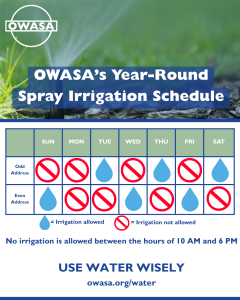
OWASA does impose year-round water use restrictions for customers, focused on irrigation (see graphic below). Click HERE to read the full Water Conservation Standards policy. OWASA will continue to update the community if drought conditions become more severe and additional water use restrictions are imposed.
Frequently Asked Questions
- What are OWASA’s sources of water? Our community’s water supply comes from University Lake, Cane Creek Reservoir, and Quarry Reservoir. We also have an allocation for Jordan Lake water that can be transferred from the Town of Cary through the City of Durham’s system through a mutual aid agreement. We are working with our regional utility partners to evaluate the use of our Jordan Lake allocation to relieve immediate demand on our reservoirs.
- How can I track OWASA’s water supply? You can track reservoir levels and community water use on our Water Watch web page. We update the data every week day.
- What can I do NOW to save water? OWASA customers should, first, log in to Agua Vista! There, you can look at your hourly water use, find customized water conservation tips, and make sure you’re getting leak alerts to stop them early. You can also turn on notifications that will alert you when you’re using more water than usual or elect to receive bill forecasts based on your mid-month water use. You can pick up a FREE water conservation kit from OWASA Customer Service (at 400 Jones Ferry Road in Carrboro) during business hours (8 a.m. to 5 p.m.) Monday through Friday.
- What’s the difference between a drought and a water shortage? A drought is defined based on how much rain an area has gotten during a certain period of time compared to normal rainfall for the area. The North Carolina drought monitor is updated every Thursday. A water shortage is defined by each water provider based on specific criteria that are not the same for all providers. For OWASA, water shortage is defined by how much water is in our reservoirs, average water demand, and the time of year.
- Why hasn’t OWASA enacted water use restrictions? Based on our modeling, OWASA is not yet in a water shortage.
- When will we enact restrictions? Water use restrictions and water use surcharges will be enacted when we enter Stage 1 of a water shortage. Stage 1 is triggered during fall months if our combined community’s water supply (Cane Creek Reservoir, University Lake, and the Quarry Reservoir) decreases to 40% full. A Water Shortage Advisory will be issued if it decreases to 50% to prepare the community for the restrictions that would come in Stage 1.
- What will restrictions be if we enter Stage 1 of a water shortage?
- Outdoor Watering Schedule: Spray irrigation of lawns is restricted one day per week, with odd-numbered addresses only allowed to water on Tuesdays and even-numbered addresses are only allowed to water on Thursdays. Spray irrigation of non-turf plant material is allowed 3 days per week, with odd addresses allowed Tuesday, Thursday and Saturday, and even addresses allowed on Sunday, Wednesday, and Friday. Watering must take place between 6:00 p.m. and 10:00 a.m. A maximum of 1/2 inch of water per week is permitted.
- Important Exemptions: Hand-held hoses and watering cans can be used at any time. Plant nurseries, botanical gardens, and public athletic fields can operate under approved Water Conservation Plans.
- Pricing: In Stage 1, OWASA implements water use surcharges for high consumption of residential water use starting at 6,001 gallons or more. Additionally, a water use surcharge is applied to water rates charged to multi-family customers, non-residential customers, and irrigation.
- How will my business be impacted by water shortage restrictions? OWASA is working to help prepare businesses for potential impacts of water shortage. We hope to be a good partner in working together to navigate water supply challenges during drought with residents and businesses alike. Other than the irrigation restrictions described above, most uses of water are still allowed during Stage 1. Check back here for updates, or visit our Water Shortage Response Plan for details.
Bulk Water
- Reclaimed Water: With a short, 30-minute training, you can help conserve potable water by using FREE reclaimed water for landscape irrigation, power washing, and more. Reclaimed water is highly treated wastewater that has received advanced treatment to remove pathogens and bacteria. Reclaimed water can be used for landscape irrigation, decorative ponds and fountains, vehicle washing, and power washing. Reclaimed water CANNOT be used for drinking, cooking, or bathing. Once trained, you will receive a permit card and can pick up FREE reclaimed water at the Mason Farm Wastewater Treatment Plant (170 Old Mason Farm Road; Chapel Hill) Monday through Friday, 8AM to 4PM. Users must bring and fill own tank. Please email info@owasa.org or call 919-537-4350 for more information on training and using bulk reclaimed water.
- Drinking Water: At present, drinking water is available at the OWASA Water Treatment Plant at 400 Jones Ferry Road in Carrboro between 8AM and 3:30PM. The cost for bulk drinking water is $25 per trip plus $10.54 per thousand gallons. Users must have their own tank/tanker and fire hookup to dispense the water. Please email or call Customer Service for more information at customerinquiries@owasa.org or 919-537-4343.
- OWASA does not provide water delivery of bulk water.